Home  /  The PICKI NIKI Journal
filter-technologywater-science

Vitamin C vs Activated Carbon: What's the Difference?

PICKI NIKI 7 min read
Vitamin C vs Activated Carbon: What's the Difference?
In short
  • Activated carbon and vitamin C both reduce chlorine, but in completely different ways: carbon traps it by adsorption, vitamin C neutralises it through a chemical reaction. Almost every practical difference follows from that.

  • Adsorption depends on long contact time and cooler water. A shower is the opposite: hot, fast-flowing, seconds of contact – and carbon loses adsorption capacity as temperature rises.

  • Vitamin C reacts with free chlorine in under a second, works faster rather than slower in hot water, and is visibly consumed – so replacement is based on what you can see, not a calendar estimate.

  • Neither technology filters sediment on its own, and no compact shower filter can truly soften water. Well-designed systems combine a small number of stages, each with a clearly defined job.

Two shower filters can both promise to remove chlorine – and still behave very differently in use.

The reason usually comes down to the technology inside.

Activated carbon and vitamin C can both reduce chlorine in water. But they do it in completely different ways.

One works by trapping. The other works by reacting.

That distinction explains a great deal about how a filter performs – and why it matters more in a shower than almost anywhere else.

Two Different Mechanisms

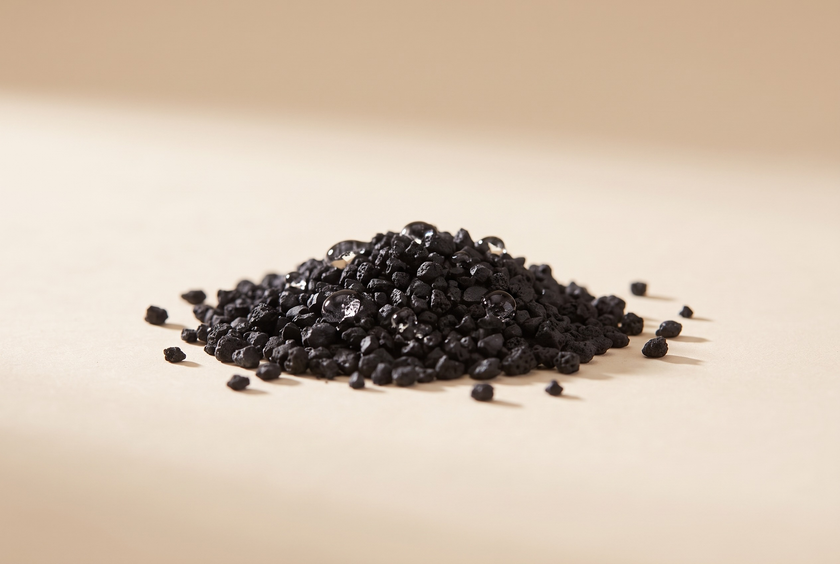
Activated carbon filters water through adsorption.

Its surface is covered in millions of microscopic pores. As water passes through, substances such as chlorine attach to that surface and are held there.

Vitamin C works differently.

It doesn't trap chlorine. It reacts with it.

When chlorine meets vitamin C – the same vitamin found in citrus fruit – a natural reaction neutralises it and converts it into harmless by-products.

Trapping versus reacting. Everything else follows from that.

The mechanisms

Trapping vs. reacting

Everything else follows from this difference.

Activated carbon: trapping

01

Activated carbon: trapping

Adsorption pulls chlorine onto a porous surface and holds it there. It needs contact time and cooler water - the conditions of a kitchen tap, not a shower.

Vitamin C: reacting

02

Vitamin C: reacting

A chemical reaction neutralises chlorine on contact, in under a second - and it runs faster, not slower, in hot water.

What Activated Carbon Does Well

Activated carbon is a proven and widely used filtration technology.

The term includes several forms of carbon-based media, including granular activated carbon (GAC) and activated carbon fibre (ACF).

Because adsorption captures a broad range of substances, carbon can reduce chlorine as well as many organic compounds associated with tastes and odours in water.

For drinking-water filtration, that breadth is a significant strength.

The Conditions Adsorption Depends On

Adsorption depends on contact time.

The longer water stays in contact with the carbon, the more effectively it works – so performance tends to fall as flow rate rises and contact time shrinks.

Temperature matters too. Adsorption is generally an exothermic process, which means higher water temperatures can reduce a carbon filter's adsorption capacity and increase the tendency for previously captured compounds to be released back into the water.

This is one reason most activated-carbon technologies were developed for drinking-water systems, where water is cooler and flows more slowly than in a shower.

None of this makes carbon ineffective.

It makes carbon conditional.

A Note on Maintenance

Because carbon removes the residual disinfectant that limits microbial growth, independent research has found that activated-carbon filters can support biofilm formation once the media is exhausted.

Exhaustion is hard to detect. Water can still look and smell clean after the carbon has stopped performing, and working life varies by water quality, usage and temperature – so no fixed replacement date fits every home.

How Vitamin C Behaves Instead

Vitamin C does not accumulate what it removes.

Because it works by reacting rather than adsorbing, chlorine is neutralised on contact and converted into harmless by-products.

The vitamin C is consumed as it works, rather than acting as a surface that collects material over time – so it does not create the same conditions for biofilm to form.

It also gives a clearer signal of when to replace it. The vitamin C gel is visibly consumed as it works, and PICKI NIKI's sediment stage shows discolouration and reduced flow as it fills. A transparent window lets you see the state of both, so replacement is based on what you can actually see rather than an estimate.

The reaction is also fast, which suits the short contact times of a real shower.

Temperature works differently here, too. Where adsorption is exothermic – so a carbon filter tends to lose capacity as water gets warmer – reaction rates generally rise rather than fall with temperature. A sediment stage, which filters particles physically, is largely unaffected by heat either. In other words, the conditions that challenge adsorption in a hot shower do not act on these mechanisms in the same way.

This reaction is well understood. The US Environmental Protection Agency documents the effectiveness of ascorbic acid for dechlorination, and vitamin C is used in professional water treatment applications precisely because the chemistry is reliable and fast.

Independent testing

KEWI lab result

Korea Environment & Water Works Institute, 2.52 L/min at 21-23°C - real shower flow, not laboratory drip rates.

0.19 mg/L → non-detectable

Free chlorine at the outlet - a removal rate of ≥99.9% under the stated test conditions

C6H8O6 + HOCl →

Ascorbic acid (vitamin C) + free chlorine

HCl + H2O + by-products (harmless)

Neutralised in under one second

Why Vitamin C Filters Aren't All the Same

Vitamin C neutralises chlorine through a direct chemical reaction – not adsorption. In water, ascorbic acid reacts with free chlorine to below detectable levels in under one second. The same chemistry is used in clinical wound care to neutralise chlorine exposure on tissue.

Temperature works in its favour, not against it. The reaction is faster in hot water – which is exactly the condition a shower filter faces. Carbon, by contrast, loses adsorption capacity above around 40°C.

In independent testing at KEWI (Korea Environment & Water Works Institute), the PICKI NIKI vitamin C stage reduced free chlorine from 0.19 mg/L to non-detectable levels – a removal rate of ≥99.9% under the stated test conditions.

The challenge is stability. As a dry powder, ascorbic acid is stable for up to a year when sealed and kept dry. Once placed in solution – or exposed to repeated water, heat and oxygen – it degrades within days. Loose powder and compressed tablet formats offer no protection from this. By the time many vitamin C filters are installed and first used, a meaningful portion of the active ingredient has already degraded. Because the depletion is invisible, there is no way for the consumer to know.

A gel matrix changes this. The stabilising medium limits the active ingredient's exposure between uses. And the amount of active ascorbic acid matters: chlorine neutralisation is stoichiometric – each molecule of ascorbic acid neutralises one molecule of chlorine. Lower concentrations deplete faster. Some filters contain enough vitamin C to make a label claim, but not enough to sustain meaningful performance across their stated lifespan.

PICKI NIKI uses a food-grade ascorbic acid gel with a transparent housing – so depletion is visible, and the filter is replaced when genuinely spent, not when a calendar says so.

Where Vitamin C Is Not the Answer

Vitamin C is highly effective at neutralising chlorine.

But on its own it does not remove sediment, particulate matter or the broad range of substances that other filtration technologies are designed to address.

Neither vitamin C nor activated carbon is primarily designed as a dedicated sediment filter for capturing larger particles such as rust, sand or grit.

Those are typically handled by a separate sediment-filtration stage.

This is why many shower-filtration systems combine multiple technologies, with each stage performing a different role.

At PICKI NIKI, we use a dual-filtration system. A sediment filter is designed to capture particles before the water reaches the vitamin C stage, where chlorine is neutralised.

So the honest answer is not that one technology is simply better than the other.

They are built for different jobs.

What This Means for a Shower

A shower's conditions are specific:

  • Chlorine
  • Hot water
  • Fast flow
  • Daily use

Under those conditions, a mechanism that neutralises chlorine quickly – without depending on long contact time and without accumulating material as it works – can offer practical advantages.

That is the reasoning behind PICKI NIKI's use of vitamin C.

Not because carbon is bad.

Because one technology depends on trapping, while the other works by reacting – and a shower is not the environment adsorption was designed for.

A shower's conditions are specific

Chlorine

in every municipal supply

Hot water

not cold

Fast flow

seconds of contact

Daily use

every single day

What "More Stages" Really Means

Shower filters are often marketed by the number of stages they contain – 10, 15, sometimes 20.

A "stage" is simply a layer of filtration media. A higher number doesn't necessarily mean better filtration: several stages may contain small amounts of the same material, and a stage only does useful work if the right media is present in a meaningful quantity and the water spends enough time in contact with it.

There's also a physical constraint: a handheld shower head has a fixed internal volume. That space is a budget: the more separate stages you divide it into, the less room each one gets. Past a certain point, adding stages doesn't add capability – it just shrinks the space available to each, which can mean less media and shorter contact time per stage. So a long stage count can involve a trade-off rather than a pure gain.

A smaller number of well-chosen stages, each doing a clearly defined job, can outperform a longer list of token layers. The useful question isn't "how many stages?" but "what does each stage actually do, and is there enough of it to matter?"

What a Shower Filter Can't Do

It's just as important to be clear about limits.

A compact shower filter is not a water softener. True softening – actually removing calcium and magnesium from water – requires an ion-exchange resin bed and a regeneration cycle, which is why whole-home softening systems are the size they are. The American Water Works Association is clear that this kind of full softening isn't something a handheld shower device can do.

What a shower filter can do is reduce the effects of hard water – for example by helping minerals form soluble complexes that rinse away more easily, so less residue is left behind. That's a genuine and useful difference in how water feels, but it isn't the same as softening – and the distinction matters.

The Evidence on Hard Water

The interest in shower water isn't only about chlorine. Peer-reviewed research has found associations between hard water and skin-barrier disruption – with hardness, rather than chlorine, as the more consistent signal across the studies reviewed.

This does not mean a shower filter treats or prevents any skin condition. It is the backdrop to why some people choose to address the water itself.

For a fuller look at the research, including the specific studies and what they do and don't show: Why Does My Skin Feel Dry After Showering?

Evidence & sources

References

Sources for individual claims, marked with footnote numbers in the text. Peer-reviewed papers are cited in support of underlying mechanisms, not as proof of product efficacy.

1.

Folkes et al., 1995 - cited in Kristiana I et al., Water Supply (IWA Publishing), 2021

Ascorbic acid reacts with free chlorine to below detection levels in under one second, under ultrapure water conditions.

2.

Wu CC et al. Environmental Science: Water Research & Technology (RSC), 2017

Activated carbon block filters significantly alter bacterial abundance; bacteria can grow within the filter media.

3.

Fresh Water Systems / AWWA

Activated carbon adsorption capacity decreases as water temperature increases; carbon filters are designed for cold or room-temperature water, not hot shower applications.

4.

KEWI (Korea Environment & Water Works Institute)

Independent test: PICKI NIKI vitamin C stage reduced free chlorine from 0.19 mg/L to non-detectable (≥99.9%) at 2.52 L/min, 21-23°C.

LAB TEST
5.

ACS Omega and related peer-reviewed studies

Exothermic nature of activated-carbon adsorption and reduced capacity at higher temperatures.

6.

Environmental Science: Water Research & Technology (Royal Society of Chemistry), 2017

Microbial colonisation of activated-carbon point-of-use filters.

7.

Water Quality Association

Granular Activated Carbon fact sheet (contact time, flow rate).

8.

American Water Works Association

Water softening (ion-exchange) principles.

9.

Danby SG et al. Journal of Investigative Dermatology, 2018

Hard water, surfactant deposition and skin-barrier irritation (n=80).

10.

Perkin MR et al. Journal of Allergy and Clinical Immunology, 2016

Domestic water hardness and atopic dermatitis risk in infants (n=1,303).

11.

Jabbar-Lopez ZK et al. Clinical & Experimental Allergy, 2021

Systematic review and meta-analysis of water hardness and atopic eczema.

Frequently Asked Questions

Does hot or fast-flowing water affect activated carbon?

It can. Adsorption depends on contact time, and a shower moves water through a compact filter in seconds – far less than the longer contact times associated with drinking-water filtration. Higher water temperatures can also reduce adsorption capacity, because adsorption is generally an exothermic process. This is one reason shower conditions differ from the conditions carbon was originally designed for.

How do I know when to replace a carbon filter?

It can be difficult to tell. A carbon filter's life depends on water quality, usage, temperature and flow, and the water can still look and smell clean after the carbon has stopped performing – so replacement timing is often based on estimates rather than a clear signal.

Is activated carbon bad?

No. Activated carbon is one of the most widely used filtration technologies in the world and can be highly effective when used under appropriate conditions.

Why do some shower filters use vitamin C instead of carbon?

Different filtration technologies behave differently under different conditions. In shower environments, factors such as hot water, fast flow and limited contact time can influence which technologies manufacturers choose to use.

Do more filter stages mean better filtration?

Not necessarily. A "stage" is a layer of filtration media, and several stages can contain small amounts of the same material. What matters is what each stage is made of, how much of it there is, and whether the water is in contact with it long enough to do useful work – not the headline number.

Can a shower filter soften hard water?

No. True softening removes calcium and magnesium and requires an ion-exchange resin bed with a regeneration cycle, which isn't possible in a compact shower device. A shower filter can reduce the effects of hard water – for example by helping minerals rinse away with less residue – but that isn't the same as softening.

Which is better for a shower: vitamin C or activated carbon?

Neither is universally better. Activated carbon is a proven technology that performs well under the conditions it was designed for, particularly drinking-water filtration. Vitamin C offers practical advantages in shower environments because it neutralises chlorine rapidly without depending on long contact times, and its performance is not reduced by the heat or flow rate of a real shower. The right choice depends on the conditions the filter is designed to operate in.

The PICKI NIKI Vitamin C Shower Filter

Try it yourself

The PICKI NIKI Vitamin C Shower Filter

Designed for European water, third-party tested, 60-day risk-free trial.

Start Your 60-Day Trial