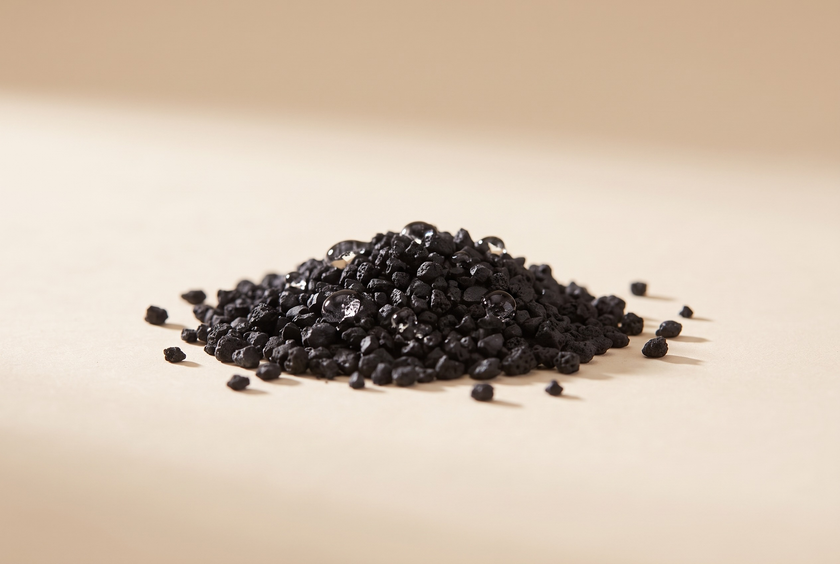
Ce que le charbon actif fait bien
Le charbon actif est l'un des matériaux de filtration les plus utilisés au monde, et pour de bonnes raisons. Le terme recouvre plusieurs formes, dont le charbon actif en grains (CAG) et la fibre de charbon actif (ACF). Comme le charbon réduit le chlore libre et adsorbe aussi de nombreux composés organiques responsables des goûts et des odeurs, il offre une polyvalence que la vitamine C n'a pas.
Pour l'eau potable, cette polyvalence est un vrai point fort.
Ce qui détermine la durée de vie du charbon
La durée pendant laquelle une cartouche de charbon reste efficace dépend de la quantité de charbon qu'elle contient, du volume d'eau qui la traverse et de ce que cette eau transporte. La Water Quality Association considère le temps de contact, c'est-à-dire le temps que l'eau passe dans le lit de charbon, comme le paramètre clé de conception des filtres à charbon. Pour le chlore, il détermine surtout combien de temps le charbon tient, moins si le chlore est réduit ou non.
Une douche fait passer chaque jour beaucoup d'eau dans une petite cartouche. C'est l'une des raisons pour lesquelles une douche est un endroit plus difficile à filtrer qu'un robinet : plus d'eau, plus de chaleur et très peu de place pour le média filtrant.
La chaleur compte pour une partie de ce que le charbon retient. Selon la Water Quality Association, certains composés organiques sont volatils et peuvent être relâchés par le charbon dans l'eau chaude. Pour le chlore lui-même, en revanche, l'eau chaude n'est pas le point faible du charbon : la recherche sur le charbon et le chlore libre a montré que la réaction à la surface du charbon s'accélère quand l'eau se réchauffe. L'argument en faveur de la vitamine C sous la douche ne repose donc pas sur l'idée que la chaleur affaiblit le charbon.
Rien de tout cela ne rend le charbon inefficace. Cela en fait une question de capacité.
Un mot sur l'entretien
Des recherches évaluées par des pairs montrent que les filtres à charbon actif peuvent abriter un biofilm bactérien, il est donc important de les remplacer à temps. Savoir quand une cartouche de charbon est épuisée est plus difficile qu'il n'y paraît. Sa durée de vie varie selon la qualité de l'eau, l'usage et la température, et une cartouche en fin de vie ressemble généralement de l'extérieur à une cartouche neuve. C'est pourquoi aucune date de remplacement fixe ne convient à tous les foyers.
Comment la vitamine C se comporte
La vitamine C n'accumule pas ce qu'elle élimine. L'acide ascorbique neutralise le chlore libre par une réaction d'oxydoréduction et le transforme en chlorure inoffensif, selon le même principe que celui utilisé par les distributeurs d'eau pour déchlorer les nouvelles canalisations (AWWA C651-05). L'Agence américaine de protection de l'environnement (EPA) prescrit elle aussi l'acide ascorbique pour déchlorer des échantillons d'eau avant analyse.
Comme la vitamine C se consomme en travaillant, le filtre finit par s'épuiser. Pour un foyer de deux personnes qui se douchent tous les jours, une cartouche de vitamine C dure généralement deux à quatre semaines, et une cartouche vide a simplement fait son travail.
L'avantage, c'est que tu peux le voir. Le gel de vitamine C de PICKI NIKI se trouve derrière une fenêtre à l'arrière du pommeau, et le filtre à sédiments est visible par la fenêtre de la poignée. Tu remplaces donc chaque filtre d'après ce que tu vois, pas d'après un calendrier.
La température de la douche ne change rien à la chimie : la réaction avec le chlore libre est quasi instantanée, que l'eau soit tiède ou chaude. Ce qu'une eau plus chaude peut changer, c'est la vitesse à laquelle le gel se dissout. De longues douches chaudes peuvent donc épuiser le filtre plus tôt.