Shower filters are an easy product to sell badly. The category is full of vague language: "spa water," "purified," "revitalising." None of those words mean anything measurable, and most shoppers end up choosing on price or packaging because there is nothing else to compare.
We founded PICKI NIKI in 2022 and have been building shower filters for European water ever since. The decision is not complicated once you know what to look at. Five things actually matter, and four of them are easy to check before you buy.
This guide walks through each one, with a comparison framework at the end you can use on any filter, including ours.
What the filter actually removes
Start here, because most product pages skip it. A shower filter cannot remove everything, and a brand that implies otherwise is not being straight with you.
What a shower filter can realistically address is free chlorine and sediment. A good filter tells you which of these it targets, how it was tested and under what conditions. "Removes impurities" is not an answer. A named lab, a starting value, a result and the test conditions are. Ours, for example: in a 2020 KEWI test, free chlorine went from 0.19 mg/L to non-detectable over 100 litres at 2.52 L/min and 22 °C. KEWI is not KOLAS or ISO 17025-accredited, and real shower flow on our head is 7.5 L/min, so we state both.
One thing no shower filter does is soften water. Hardness comes from dissolved calcium and magnesium, and removing those at shower flow is not practical in a compact cartridge. If a shower filter claims to soften your water, treat every other claim on the page with suspicion.
The filter media: vitamin C, carbon or KDF
The media is the part that does the work, and there are three common types.
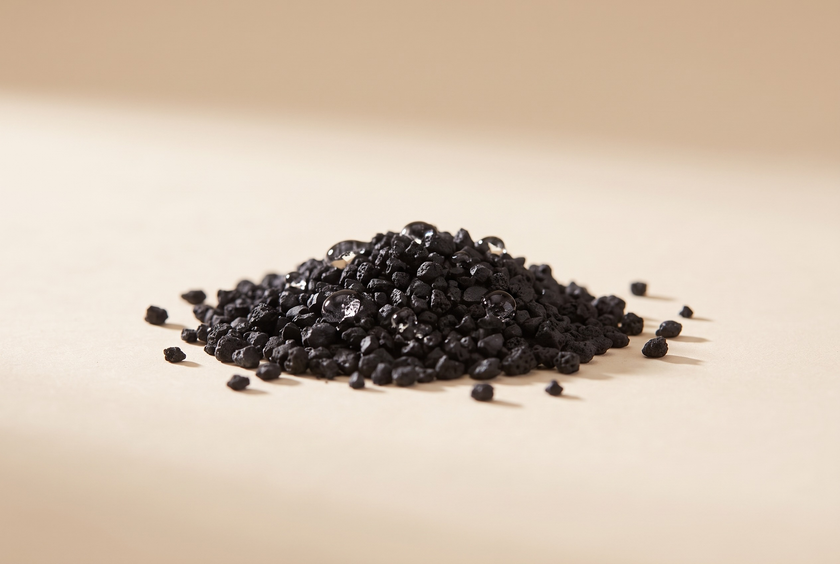
Activated carbon is the most widely used. Free chlorine is reduced on its surface, and it also adsorbs many of the organic compounds behind tastes and odours. Its limit is capacity: the surface slowly becomes less active, and a spent carbon cartridge looks the same as a new one, so it is hard to tell when it has stopped doing its job.
KDF is a copper-zinc medium used in many multi-stage shower filters. As with any medium, ask for test results for the specific filter rather than a general description of the material.
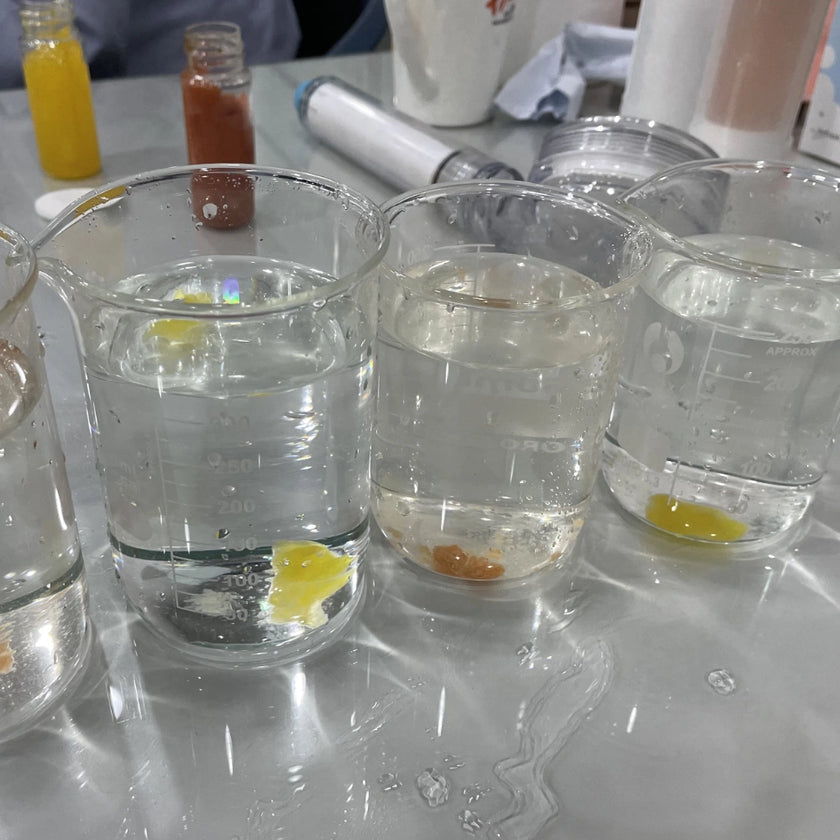
Vitamin C (ascorbic acid) reacts with free chlorine on contact, effectively instantaneously and at any shower temperature. It is used up as it works, so the real difference from carbon is what runs out and whether you can see it. Many strong filters combine a sediment pre-filter with a vitamin C stage, which is the setup we use.
There is no single correct media, but you should know which one you are buying and why.
Cartridge lifespan and the real running cost
The sticker price of a shower filter is close to meaningless. The number that matters is cost per month, and that depends on cartridge life.
Cartridge life follows the chemistry of the media; it is not a quality score. A reactive medium like vitamin C is used up as it neutralises chlorine, so it is replaced more often by design. Ours typically lasts two to four weeks for a household of two showering daily, and our sediment cartridge one to three months, depending on water quality and usage. A carbon cartridge usually runs for several months, but because its capacity fades without a visible sign, the date on the box is an estimate rather than a signal. A short-lived reactive cartridge and a long-lived carbon cartridge are not better or worse than each other. They are different media on different schedules.
What matters is that the brand publishes its cartridge life, so you can find the replacement price and the stated lifespan and work out the annual cost before you buy. If a brand does not publish cartridge life, that is a meaningful red flag.
Flow rate and pressure compatibility
A filter that noticeably weakens your shower will not stay on it for long.
Any cartridge adds some resistance, and many European bathrooms run at modest pressure or on an electric instantaneous water heater, which typically supplies only about 6 L/min. So ask what flow a filter was tested at and whether the brand has tried it at low flow. In our own flow tests, with restrictors in the shower hose, 6 L/min was fully sufficient and 8 L/min felt completely everyday-proof.
You cannot fully test this before buying, so look for a return policy long enough to try the filter in your own bathroom.
Third-party testing you can actually check
The last criterion separates serious brands from the rest. Anyone can write "clinically tested" on a box. The question is whether they will tell you who did the testing, and on what basis.
Look for named laboratories and named standards. Our filter, for example, was tested at three named Korean laboratories: KEWI for chlorine and a 60-parameter drinking-water panel, KTR for pH neutralisation, and the P&K Skin Clinical Research Centre for clinical skin tolerability. None of these test reports was issued under KOLAS or ISO 17025 accreditation. KTR is an accredited institute, but our pH test was a commissioned contract test outside that scope, and we say so. Separately, our Korean manufacturing partner works under ISO 9001:2015 and ISO 14001:2015 management-system certifications, which cover how the product is made, not how it performs.
You do not need to memorise any of that. You need to confirm that a brand names its testing and its conditions at all, because a percentage means little without the conditions that produced it.
Shower filter or whole-house softener?
A question worth settling before you spend anything: do you need a shower filter or a whole-house water softener? They solve different problems.
A whole-house softener removes calcium and magnesium by ion exchange across your entire plumbing. It genuinely softens water, but it is a plumbed-in installation that usually needs a professional, and it is often not an option in a rented flat.
A shower filter treats only the water that reaches your skin and hair. It does not soften water, so hardness stays in the water. What it does is reduce free chlorine and capture sediment, and a filtered shower head like ours simply takes the place of your current one.
If your goal is less limescale on tiles and glass, you need a plumbed-in water softener. If your goal is water that feels less harsh on skin and hair, a shower filter is the relevant tool.