Home  /  The PICKI NIKI Journal
filter-technologywater-science

Vitamin C vs Activated Carbon: What's the Difference?

PICKI NIKI 7 min read
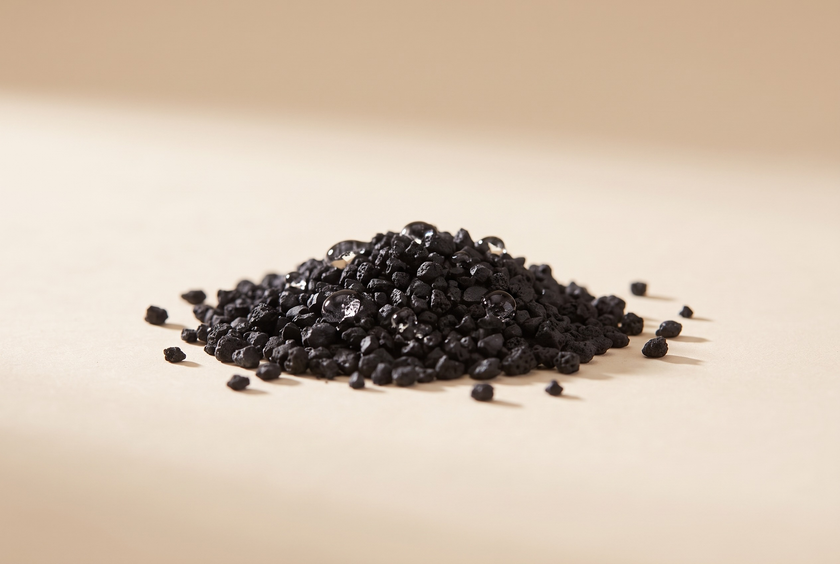
Granular activated carbon on a warm studio surface
In short
  • Activated carbon and vitamin C both reduce free chlorine, and both do it chemically. The difference is what gets used up: carbon is a surface with a limited capacity, vitamin C is a supply that shrinks with every shower.

  • How long carbon lasts depends on how much of it a cartridge holds and how much water passes through. A shower sends a lot of water through a small cartridge every day, and a spent carbon cartridge looks the same as a new one.

  • Vitamin C reacts with free chlorine on contact, effectively instantaneously and at any shower temperature. It is visibly consumed, so replacement is based on what you can see, not a calendar estimate.

  • Neither technology filters sediment on its own, and no shower filter softens water. Well-designed systems combine a small number of stages, each with a clearly defined job.

Two shower filters can both promise to remove chlorine and still behave very differently once they are on your shower arm. Most of that difference comes from the material inside.

Activated carbon and vitamin C both reduce free chlorine, and both do it chemically, which surprises anyone who pictures carbon as a sponge. Where they part ways is in what gets used up, how quickly, and whether you can tell when it has run out.

Two Different Mechanisms

Activated carbon is a surface. Its pores give a single gram an enormous internal area, and when chlorinated water flows through, free chlorine reacts on that surface and is reduced to chloride. Other substances, mostly the organic compounds behind tastes and odours, are held in the pores by adsorption. Over time the surface becomes less active and fills up, which is why every carbon cartridge has a limited capacity.

Vitamin C works the other way round. Ascorbic acid is itself the reagent: it reacts with free chlorine on contact, effectively instantaneously and at any shower temperature, and turns it into harmless chloride. Each reaction uses up a little vitamin C, so the filter is consumed as it works.

So the real question is what runs out. With carbon, it is a surface that slowly loses capacity. With vitamin C, it is a supply that gets smaller with every shower.

The mechanisms

Surface vs. supply

Both reduce chlorine. What differs is what runs out.

Activated carbon: a surface

01

Activated carbon: a surface

Free chlorine is reduced on the carbon surface, and many organic compounds are held in its pores. The surface slowly loses capacity, and a spent cartridge looks like a new one.

Vitamin C: a supply

02

Vitamin C: a supply

Vitamin C reacts with free chlorine on contact, at any shower temperature, and is used up as it works. A window shows you how much is left.

What Activated Carbon Does Well

Activated carbon is one of the most widely used filtration materials in the world, and for good reason. The term covers several forms, including granular activated carbon (GAC) and activated carbon fibre (ACF). Because carbon handles free chlorine and also adsorbs many of the organic compounds behind tastes and odours, it offers a breadth that vitamin C does not have.

For drinking water, that breadth is a real strength.

What Decides How Long Carbon Lasts

How long a carbon cartridge keeps working depends on how much carbon it holds, how much water passes through it and what that water carries. The Water Quality Association treats contact time, the time water spends in the carbon bed, as the key design figure for carbon filters. For chlorine it mainly decides how long the carbon lasts, less whether the chlorine is reduced at all.

A shower pushes a lot of water through a small cartridge every day. That is part of why a shower is a harder place to filter water than a tap: more water, more heat and very little room for filter media.

Heat matters for some of what carbon holds. According to the Water Quality Association, some organic compounds are volatile and can be released from carbon again in hot water. For chlorine itself, warm water is not carbon's weak point: research on carbon and free chlorine found the reaction on the carbon surface speeds up as the water gets warmer. So the case for vitamin C in a shower does not rest on heat weakening carbon.

None of this makes carbon ineffective. It makes it a question of capacity.

A Note on Maintenance

Peer-reviewed research shows that activated carbon filters can harbour bacterial biofilm growth, so replacing them on time matters. Knowing when a carbon cartridge is spent is harder than it sounds. Its working life varies with water quality, usage and temperature, and a cartridge near the end of its life usually looks the same from the outside as a new one. That is why no fixed replacement date fits every home.

How Vitamin C Behaves Instead

Vitamin C does not collect what it removes. Ascorbic acid neutralises free chlorine through a redox reaction and converts it to harmless chloride, the same principle water utilities use when they dechlorinate new water mains (AWWA C651-05). The US Environmental Protection Agency also specifies ascorbic acid for dechlorinating water samples before analysis.

Because the vitamin C is consumed as it works, the filter does run out. For a household of two showering daily, a vitamin C cartridge typically lasts two to four weeks, and an empty cartridge has simply done its job.

The advantage is that you can watch it happen. PICKI NIKI's vitamin C gel sits behind a window on the back of the shower head, and the sediment filter is visible through the handle window, so you replace each one on what you see rather than on a calendar.

Shower temperature does not change the chemistry: the reaction with free chlorine is effectively instantaneous whether the water is lukewarm or hot. What warmer water can change is how quickly the gel dissolves, so long, hot showers may use the filter up sooner.

Independent testing

KEWI lab result

Korea Environment & Water Works Institute, 2020: 100 L at 2.52 L/min, 22 °C. KEWI is not KOLAS / ISO 17025-accredited. Real shower flow on this head, measured by KTR, is 7.5 L/min.

0.19 mg/L → non-detectable

Free chlorine at the outlet. The report gives no detection limit, so no percentage is derived.

C6H8O6 + HOCl →

Ascorbic acid (vitamin C) + free chlorine

C6H6O6 + HCl + H2O

Dehydroascorbic acid + chloride + water, on contact

Why Vitamin C Filters Aren't All the Same

The chemistry is the same in every vitamin C filter. What differs is how much vitamin C a cartridge holds, how it is held, and whether the brand can show how the filter performs.

Since every reaction with chlorine uses up some vitamin C, the amount in the cartridge decides how long it lasts. A useful filter states its lifespan and lets you check it. PICKI NIKI holds its vitamin C as a gel behind a transparent window, so you can see how much is left.

For performance, look for a named lab test with its conditions. In independent testing at KEWI (Korea Environment & Water Works Institute) in 2020, the PICKI NIKI vitamin C stage reduced free chlorine from 0.19 mg/L to non-detectable, over 100 litres at 2.52 L/min and 22 °C. Two details belong next to that result. KEWI is a government-designated drinking-water testing institute, but it is not KOLAS or ISO 17025-accredited. And real shower flow on this head, measured by KTR, is 7.5 L/min, about three times the test flow. The report also gives no detection limit, so we don't turn "non-detectable" into a percentage.

Where Vitamin C Is Not the Answer

Vitamin C is very good at one job: neutralising free chlorine. On its own it does not remove sediment, particles or the wider range of organic compounds that carbon adsorbs. Neither vitamin C nor carbon is meant to catch larger particles such as rust, sand or grit, which is the work of a separate sediment stage.

That is why many shower filters combine stages, each with its own role. PICKI NIKI uses two. A sediment pre-filter (nominal 5 µm) captures the particles old plumbing releases, such as rust, metal flakes, sand and grit, before the water reaches the vitamin C stage, where chlorine is neutralised.

So neither technology is simply better. They are built for different jobs.

What This Means for a Shower

A shower's conditions are specific:

  • Chlorine
  • Hot water
  • Fast flow
  • Daily use

Under those conditions, a filter that neutralises chlorine on contact at any temperature and shows you when it is used up has practical advantages. That is the reasoning behind PICKI NIKI's use of vitamin C. Carbon is not a bad material. It is a surface with a limited capacity you cannot see, and a shower sends a lot of water through a small space every day.

A shower's conditions are specific

Chlorine

in every municipal supply

Hot water

not cold

Fast flow

seconds of contact

Daily use

every single day

What "More Stages" Really Means

Shower filters are often marketed by the number of stages they contain: 10, 15, sometimes 20.

A "stage" is simply a layer of filter media, and a higher number doesn't necessarily mean better filtration. Several stages may hold small amounts of the same material, and a stage only does useful work if the right media is there in a meaningful quantity and the water spends enough time in contact with it.

There is also a physical limit. A handheld shower head has a fixed internal volume, and the more stages you divide it into, the less room each one gets. Past a certain point, adding stages doesn't add capability; it just leaves less media and shorter contact time per stage. A smaller number of well-chosen stages, each with a clear job, can outperform a longer list of token layers. The useful question isn't "how many stages?" but "what does each stage do, and is there enough of it to matter?"

What a Shower Filter Can't Do

Being clear about limits matters just as much. A compact shower filter is not a water softener. True softening removes calcium and magnesium from the water and needs an ion-exchange resin bed with a regeneration cycle, which is why whole-home softeners are the size they are. No shower filter softens water: hardness stays in the water, and PICKI NIKI is not a water softener.

If your goal is less limescale on tiles and glass, you need a plumbed-in water softener. If your goal is water that feels less harsh on skin and hair, a shower filter is the relevant tool. For how hardness is measured and why it varies so much between cities, see what makes water hard.

The Evidence on Hard Water

Interest in shower water isn't only about chlorine. Peer-reviewed research suggests hard water may aggravate discomfort in people with sensitive skin, and in the studies reviewed, hardness rather than chlorine was the more consistent signal.

This does not mean a shower filter treats or prevents any skin condition. It is the background to why some people choose to look at the water itself. The individual studies, and what they do and don't show, are covered in Why Does My Skin Feel Dry After Showering?

Go deeper: Every Shower Filter Technology, Explained – how vitamin C, KDF-55, carbon and other media compare at real shower temperature, flow and contact time.

See also: Vitamin C Shower Filter – what it is, how the chemistry works, and who notices the difference.

Evidence & sources

References

Sources behind the statements in this article. Peer-reviewed papers are cited for the underlying chemistry and research, not as proof of product efficacy.

1.

Folkes LK, Candeias LP, Wardman P Archives of Biochemistry and Biophysics, 1995

Hypochlorous acid reacts with ascorbate too fast for direct stopped-flow measurement.

2.

Wu CC et al. Environmental Science: Water Research & Technology (RSC), 2017

Activated carbon block filters significantly alter bacterial abundance; bacteria can grow within the filter media.

3.

McCreary JJ, Snoeyink VL Environmental Science & Technology, 1977

Free chlorine is reduced on the surface of granular activated carbon; the reaction speeds up as water temperature rises.

4.

KEWI (Korea Environment & Water Works Institute) Residual chlorine removal test, 2020

PICKI NIKI vitamin C stage: free chlorine 0.19 mg/L to non-detectable, 100 L at 2.52 L/min, 22 °C.

KEWI is not KOLAS / ISO 17025-accredited. Real shower flow measured by KTR: 7.5 L/min.

LAB TEST
5.

Pattison DI, Hawkins CL, Davies MJ Chemical Research in Toxicology, 2009

Rate constant for hypochlorous acid and ascorbate of about 6 × 10⁶ M⁻¹ s⁻¹ at room temperature.

6.

US Environmental Protection Agency Method 524.2

Specifies ascorbic acid to dechlorinate water samples before analysis.

7.

Water Quality Association Granular Activated Carbon fact sheet, 2016

Contact time as the design figure for carbon filters; some volatile organic compounds can be released from carbon in hot water.

8.

US EPA WaterSense; Water Quality Association Cation Exchange Water Softeners, 2024; Ion Exchange Basics, 2023

Softening removes hardness ions in an ion-exchange resin bed that has to be regenerated.

9.

Danby SG et al. Journal of Investigative Dermatology, 2018

Hard water, surfactant deposition and skin-barrier irritation (n=80).

10.

Perkin MR et al. Journal of Allergy and Clinical Immunology, 2016

Domestic water hardness and atopic dermatitis risk in infants (n=1,303).

11.

Jabbar-Lopez ZK et al. Clinical & Experimental Allergy, 2021

Systematic review and meta-analysis of water hardness and atopic eczema.

12.

American Water Works Association AWWA C651-05, Disinfecting Water Mains

Ascorbic acid is among the agents used to dechlorinate water after mains disinfection.

Frequently Asked Questions

Does hot or fast-flowing water affect activated carbon?

Partly. For chlorine, warm water is not carbon's weak point: the reaction on the carbon surface speeds up as the water gets warmer. Flow matters more. The more water passes through a small cartridge, the sooner its capacity is used up. Hot water can also release some previously adsorbed organic compounds from carbon.

How do I know when to replace a carbon filter?

It can be hard to tell. A carbon cartridge's life depends on water quality, usage and how much carbon it contains, and a spent cartridge usually looks the same as a new one. Replacement is therefore often based on the manufacturer's estimate rather than a visible signal.

Is activated carbon bad?

No. Activated carbon is one of the most widely used filtration technologies in the world and can be highly effective when used under appropriate conditions.

Why do some shower filters use vitamin C instead of carbon?

Different filtration technologies behave differently under different conditions. In shower environments, factors such as hot water, fast flow and limited contact time can influence which technologies manufacturers choose to use.

Do more filter stages mean better filtration?

Not necessarily. A "stage" is a layer of filtration media, and several stages can contain small amounts of the same material. What matters is what each stage is made of, how much of it there is, and whether the water is in contact with it long enough to do useful work – not the headline number.

Can a shower filter soften hard water?

No. True softening removes calcium and magnesium and needs an ion-exchange resin bed with a regeneration cycle, which a compact shower device cannot hold. Hardness stays in the water. If limescale on tiles and glass is the problem, a plumbed-in softener is the tool. If it is how the water feels on skin and hair, a shower filter is the relevant one.

Which is better for a shower: vitamin C or activated carbon?

Neither is universally better. Activated carbon is a proven technology that handles a broad range of substances, particularly in drinking-water filtration. In a shower, vitamin C has practical advantages: it reacts with free chlorine on contact, effectively instantaneously and at any shower temperature, and you can see when it is used up. The right choice depends on what you want the filter to do.

The PICKI NIKI Filtered Shower Head with Vitamin C

Try it yourself

The PICKI NIKI Filtered Shower Head with Vitamin C

Designed in Germany, lab-tested in Korea. 60-day money-back: shower head even if used, filters unopened.

Start Your 60-Day Trial